Explain how Mobile Originated Call ( MOC ) work ??
The MOC initiation and completion procedure is used for speech/data calls, emergency calls, subscriber controlled inputs and short messages. For subscriber controlled inputs and short messages, no traffic channel is required. The user information is transmitted to the MSC/VLR after the MOC initiation has ended (when the security functions are carried out) and using the existing signaling connection.
Call sequence
1. At first, a radio resource connection is set up. This connection provides for a signaling channel between the mobile station and the BSS on the one hand, and between the BSS and the MSC/VLR on the other. Then, the mobility management connection is set up when the mobile station sends the service request to the MSC/VLR via the signaling channel.
2. The VLR is informed of the incoming request. If required, it initiates authentication, ciphering and TMSI reallocation. The mobility management connection is used to carry out these functions (which are signaling functions).
3. When these security tests are passed successfully, the mobile station starts the call control establishment by sending the setup message. This message contains,among others, the dialed number and information elements related to the requested basic service. Equipment control is performed parrallel to the call establishment procedure. 4. The MSC/VLR performs subscription and compatibility checks. The subscription check is used to verify the subscriber’s access to a certain service, whereas the compatibility checks investigate the compatibility and the consistency of the information received in the setup message. If the requested service is a bearer service or data teleservice (e.g. facsimile), supplementary checks are carried out.
5. The MSC/VLR informs the mobile station of the successful outcome of the checks. Then, the MSC/VLR allocates a traffic channel (radio interface) and seizes a terrestrial circuit.
6. The dialed digits are analyzed to determine the destination of the call. For a call to the PSTN/ISDN, the MSC/VLR searches for a free trunk and forwards the initial address message (IAM) to the next exchange.
7. If the MSC/VLR receives the address complete message (ACM) from the network side, it informs the mobile station that alerting of the called party has been started (i.e. alert message).
8. The called party answers and the MSC/VLR is informed by means of the answer message. The call is completed towards the mobile station which immediately acknowledges the through-connection. From that moment on, the MSC/VLR starts charging.
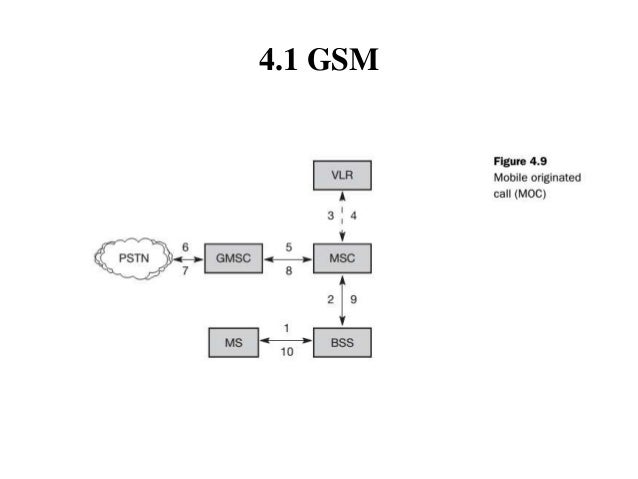
An emergency call setup differs from the normal MOC procedure in the following way.
– Emergency calls may be allowed without the subscriber identity module (SIM) being inserted in the mobile equipment. Then, the security functions are not carried out and the IMEI is used for identification purposes.
– Call setup continues irrespective of any call restrictions stored in the VLR (e.g. call barring, operator determined barring).
– The MSC/VLR must evaluate the mobile subscriber’s location, i.e. determine the location area code and the cell identity. This information is used to retrieve the location mark number (LMN) from the MSC database. The analysis of the LMN is carried out to determine the destination of the call (an appropriate emergency center).
The MOC initiation and completion procedure is used for speech/data calls, emergency calls, subscriber controlled inputs and short messages. For subscriber controlled inputs and short messages, no traffic channel is required. The user information is transmitted to the MSC/VLR after the MOC initiation has ended (when the security functions are carried out) and using the existing signaling connection.
Call sequence
1. At first, a radio resource connection is set up. This connection provides for a signaling channel between the mobile station and the BSS on the one hand, and between the BSS and the MSC/VLR on the other. Then, the mobility management connection is set up when the mobile station sends the service request to the MSC/VLR via the signaling channel.
2. The VLR is informed of the incoming request. If required, it initiates authentication, ciphering and TMSI reallocation. The mobility management connection is used to carry out these functions (which are signaling functions).
3. When these security tests are passed successfully, the mobile station starts the call control establishment by sending the setup message. This message contains,among others, the dialed number and information elements related to the requested basic service. Equipment control is performed parrallel to the call establishment procedure. 4. The MSC/VLR performs subscription and compatibility checks. The subscription check is used to verify the subscriber’s access to a certain service, whereas the compatibility checks investigate the compatibility and the consistency of the information received in the setup message. If the requested service is a bearer service or data teleservice (e.g. facsimile), supplementary checks are carried out.
5. The MSC/VLR informs the mobile station of the successful outcome of the checks. Then, the MSC/VLR allocates a traffic channel (radio interface) and seizes a terrestrial circuit.
6. The dialed digits are analyzed to determine the destination of the call. For a call to the PSTN/ISDN, the MSC/VLR searches for a free trunk and forwards the initial address message (IAM) to the next exchange.
7. If the MSC/VLR receives the address complete message (ACM) from the network side, it informs the mobile station that alerting of the called party has been started (i.e. alert message).
8. The called party answers and the MSC/VLR is informed by means of the answer message. The call is completed towards the mobile station which immediately acknowledges the through-connection. From that moment on, the MSC/VLR starts charging.
An emergency call setup differs from the normal MOC procedure in the following way.
– Emergency calls may be allowed without the subscriber identity module (SIM) being inserted in the mobile equipment. Then, the security functions are not carried out and the IMEI is used for identification purposes.
– Call setup continues irrespective of any call restrictions stored in the VLR (e.g. call barring, operator determined barring).
– The MSC/VLR must evaluate the mobile subscriber’s location, i.e. determine the location area code and the cell identity. This information is used to retrieve the location mark number (LMN) from the MSC database. The analysis of the LMN is carried out to determine the destination of the call (an appropriate emergency center).

Comments
Post a Comment